
 中文
中文
News & Events
At a family gathering during the Spring Festival, relatives sat around the table chatting and laughing. My father, who has enjoyed baijiu for years, poured himself a glass as usual and brought it close to his nose. Sitting beside him, I said, “Dad, that one’s a classic sauce-aroma baijiu.” My cousin, who rarely drinks, overheard me. She leaned over, curious. “What does sauce-aroma actually mean? I keep hearing that term, but I’ve never understood it.”
I put down my chopsticks and tried to explain using the professional terms I had learned at Moutai Institute. After a few sentences, her expression shifted from curiosity to confusion. She lifted the glass, sniffed it, set it back down, and smiled. “So what does it actually taste like? I still can’t picture anything you just said.” I opened my mouth and closed it again. For a moment, all I could hear was the soft clink of chopsticks around me. That was when it hit me: I understood it in theory, but I had no idea how to share it in my own words. All those technical terms meant nothing to someone who didn’t drink. The conversation stayed in my head for a long time afterward.
I wanted another chance to try, this time with a different approach. Not long after, my university recruited student volunteers for the Chinese Wine Open Class on Campus. I signed up. Before each session, I familiarized myself with the wines we would present. When the event began, students often walked up with their glasses and asked, “What does this one actually taste like?” At first, I answered the way I always had, using textbook language. But watching them nod politely without real understanding, I knew I was falling into the same trap. The textbook had given me the words, but not the bridge to anyone else’s experience. I had to find that bridge myself.
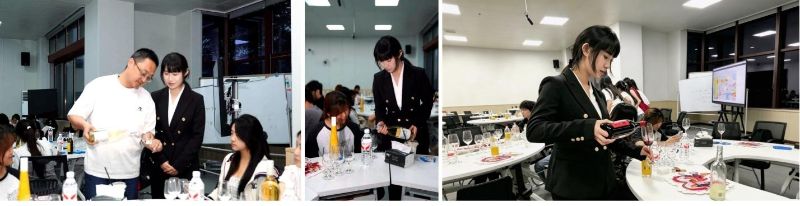
Jiang Shiyu (the author) volunteering at the Chinese Wine Open Class on Campus, serving wine and introducing wines to students.
So I tried something different. Instead of starting from the wine, I started from the person in front of me. I would ask what they usually drank, what foods they liked, whether certain smells from their kitchen or hometown stuck with them. Then, drawing on what they told me, I would search for a point of connection between the wine in their glass and something they already knew. Sometimes I’d reach for a comparison that made perfect sense in my head, and the student would tilt their head and say, “Hmm, I don’t really feel that.” Those moments were more useful than I expected. They told me I was still talking about the wine, not to the person in front of me. Slowly, I stopped thinking of explanation as pouring knowledge into someone, and started thinking of it as meeting them where their senses already were.
The way people responded changed completely. They didn’t just nod politely. Their eyes lit up. They lifted the glass again, smelled it more carefully, and sometimes even laughed and said, “Yeah, I actually get that now.” Those reactions told me something I hadn’t really thought about before. Knowing something for myself and being able to hand it to someone else are two completely different things. The term is mine until the person across from me actually feels it. Only then does the understanding belong to both of us.
A few weeks later, I went home for a weekend, and my cousin happened to be visiting. I poured her a small glass of sauce-aroma baijiu, the same kind that had stumped me before. This time, I didn’t reach for a textbook word. I asked her if she remembered the smell of grain steaming in an old wooden steamer, the faintly toasted warmth of rice crust at the bottom of an iron pot, and that deep, mellow aroma that seems to rise slowly from something aged and carefully kept. She thought for a moment, then took a careful sniff at the glass. “Oh,” she said quietly. “Oh, I think I see what you mean now.” It was the same baijiu, the same person, the same word, “sauce-aroma.” Only this time, it had landed.
Somewhere along the way, I began to see the motto of Moutai Institute, Shan Niang and Du Xing, or “Mastery in Brewing and Earnest Practice” in a new light. Brewing isn’t only about what happens inside a distillery. Taking a flavor or a piece of knowledge and turning it into words that don’t make people frown, words that finally land in someone else’s mind, maybe that, too, is a kind of brewing.
Authored by Jiang Shiyu, Class 241, Food Quality and Safety, Moutai Institute
Written under the guidance of Ms. Yang Wei, English Lecturer at Moutai Institute
First Review Xueting Zhao
Second Review Qing Ma
Third Review Jiangfang Wang
-

Tel:+86 851 28797047
-

Fax:+86 851 28797002
-

E-mail: oce@mtxy.edu.cn
-

Postcode: 564500
-

Add:Luban Ave., Renhuai, Zunyi, Guizhou, China


- Copyright © Copyright 2015-2016
- Your website security number: 52038202001601
- website filing number: QIICP18000375-1